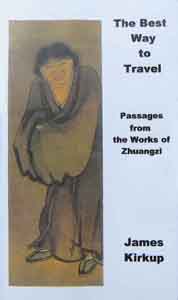
�gPassages from the Works of Zhuangzi�h is the subtitle of this book. Zhuangzi is ‘‘Žq in Japanese who early historical sources say flourished as a great philosoper in China between about 350 and 300 B.C.E. Zhuangzi is also the name of the second foundational text of the Daoist philosophical and religious tradition.
This book contains 28 works. A work consists of multiple stanzas. Every stanza is written in the form of 5-7-5-7-7 syllables or in the fixed form of tanka. But the stanza is not independent of each other. A stanza conects to next stanza in its meaning. A sentece onsists of some stanza. A work should be said a verse with the rhythm of tanka. The following verse �gFREEDOM�h is the shortest example:
he pheasant walking
in the field gives a peck
at every tenth step;
and he drinks at every
hundredth step; he does not want
to earn food and drink
at the cost of being shut
in a cage. ---And so
no pheasant ever envies
the good fortune of a king.
This style of verse is certainly easier to read than a prose. The rhythm of tanka or the repition of 5 and 7 syllables must sound comfortable to the ears of English speaking people. I found five years ago a very intersting website called �gThe Tanka Psalter�h (http://www.aloha.com/~craven/psalter.html) in which one hundred and fifty psalms have been paraphrased in the form of the 5-7-5-7-7 syllable counting rhythm. A sonnet is difficult to compose because it consists of iambic pentameters. The fixed form of English tanka, which consists of phrases with odd syllables, is easier to compose. This tendency suggests further development of English tanka. To the last page of his book Mr. James Kirkup added TANKA ENVOI:TO MY STUDENTS as follows:
Knowledge is knowing
Where to find it: even more
How to use it when
It is found, before it�fs lost
Forever, then found again.
(Hub Editions Longholm East Bank Wingland Sutton Bridge Spalding Lincolnshire UK PE12 9YS)