|
|
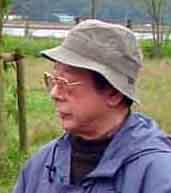
Mr. Kyuma Ohno, who tends to favor 21 syllables (3,5,3,5,5) instead of 31 syllables (5,7,5,7,7) when he composes an English tanka, about which I wrote on The Tanka Journal No. 16. He now challenges the genre of an artificial voice reading tanka. He published the works of his tanka in form of CD-ROM “The Cementum.” The cementum is the thin, fairy hard, bony tissue covering the root of a tooth. He specialized dental science in his college days. He is interested in an artificial digital voice because it does not add any feeling of a reader. I found three years ago a very interesting essay “From 5-7-5 to 8-8-8” written by Richard Gilbert and Judy Yoneoka about English haiku on a website, the World Haiku Association (http://www.worldhaiku.net/index.html). It says the sound of a Japanese word consists of morae and the sound of an English word consists of syllables. It insists a syllable is different from a mora. This theory explains well why Mr. Ohno prefers 21 syllables instead of 31 syllables. The essay says that Japanese haiku rhythm is not first determined by 5-7-5 at all; rather, the 8-8-8 metrical template is the more fundamental feature. Their phonological experiment shows that the 5-7-5 moraic structure, composed of three segments of four bi-moraic feet, making for a total of 24 morae, into which the 17 morae of 5-7-5 fit. This experiment is carried out as the free and metronome-timed reading test of 10 classic Japanese haiku by seven Japanese between the age of 14 and 23. This experiment is preliminary pilot test before their large-scale experiment in future. I do not know their large-scale experiment is done or not. In the genre of tanka Mr. Koji Kawamoto insists that a tanka also depends upon the 8-8-8-8-8 morae metrical template. I wrote it on the "Syllable Counting of an English Tanka" on The Tanka Journal No. 16. Most of native English speakers do not know how to pronounce Japanese language and do not have chances to listen to tanka read by a Japanese. The CD-ROM of “The Cementum” was nicely recorded by an artificial digital voice. It would be very helpful when such native English speakers studied how to emulate his English tanka with a Japanese native speaker's tanka in its rhythm. 3133 Noborito Tama-ku, Kawasaki-shi 214-0014 c/o Takuma. S. Fax: 044-922-1177 |

